Spelling Greek Words in English
Transliteration refers to the spelling of a word written in one alphabet in a different alphabet. For instance, the Greek name Ἀχιλλεύς is transliterated into the Latin alphabet as Akhilleus, Οἰδίπους as Oidipous, Πάτροκλος as Patroklos, and so forth. However, we don’t usually write these names and other Greek words exactly how they should be transliterated. This is largely thanks to Latin. We spell Greek words the way they were spelled in Latin, so it’s worth saying a few words about Latin spelling conventions insofar as they relate to English.
Latin used the letter c for the sound /k/, so Greek κ is spelled with c and Greek χ (/kh/) with ch. For instance, the Greek letter spelled χῖ in Greek is transliterated khi but written “chi” in Latin and English.
In Greek, the second declension masculine nominative singular ends in -ος. In Latin, it ends in -us. Thus, Patroklos is spelled Patroclus.
Greek spells the diphthongs /ay/ and /oy/ “αι” and “οι,” respectively. Latin spells them “ae” and “oe,” and it spells Greek ου (/ū/) simply “u.” So instead of Oidipous we write the name “Oedipus.”
In post-classical Latin, these diphthongs underwent monophthongization, which refers to a diphthong becoming a single phoneme. As a result, both ae and oe became e, and ei became i. This, for instance, is why we pronounce Oedipus /edipūs/, not /oydipūs/. Occasionally this has an effect on the English spelling. For instance, encyclopedia used to be spelled encyclopaedia because paedia comes from the Greek word παιδεία, “education.”
Lastly, some names had their own spelling in Latin that diverged notably from the Greek: Achilles instead of Ἀχιλλεύς, Ajax instead of Αἴας, Hercules instead of Ἡρακλέης. (This is not the same thing as, say, Greek Demeter versus Roman Ceres. This is often the result of conflating different deities who have similar attributes in the mythology.)
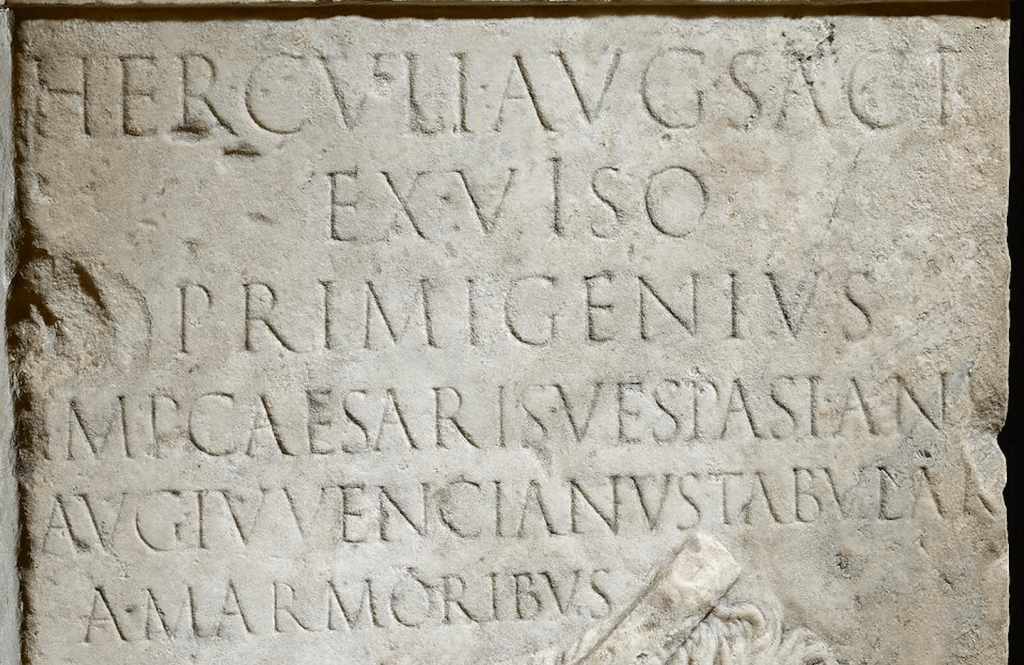
Latin inscription (above) from an altar (below) dedicated to Hercules (Rome, Italy, 69-79 CE). For details, see the altar’s page on the website of the British Museum here.

Image © The Trustees of the British Museum (CC BY-NC-SA 4.0)
 reading morphologically